My writer’s heart of hearts is one of a long-form writer. I like to research, make connections, really integrate before publishing. My drafts folder is an embarrassment of half-thought riches.
But I forget what I’m doing here sometimes. That my intent is to document my process and learnings, not always publish these introspective deep dives. So, here’s where I’m at today.
I’m halfway through the first wine course I’m taking: the WSET Level 2 Award in Wines. Level 3 is next, and I’m quite keen to get there. These two courses are commonly described as level 2 teaching the “what” of wine — rote information tested by a multiple-choice exam — and level 3 teaching the “why,” which is more theory based, tested with written answers and a blind tasting.
In level 2 we learn the Systematic Approach to Tasting (SAT). The SAT is how students objectively evaluate a wine’s quality, no matter how much our personal palate likes or dislikes it. Last week we tasted and evaluated 8 wines, all single-varietal whites. A dream come true on a Wednesday night!
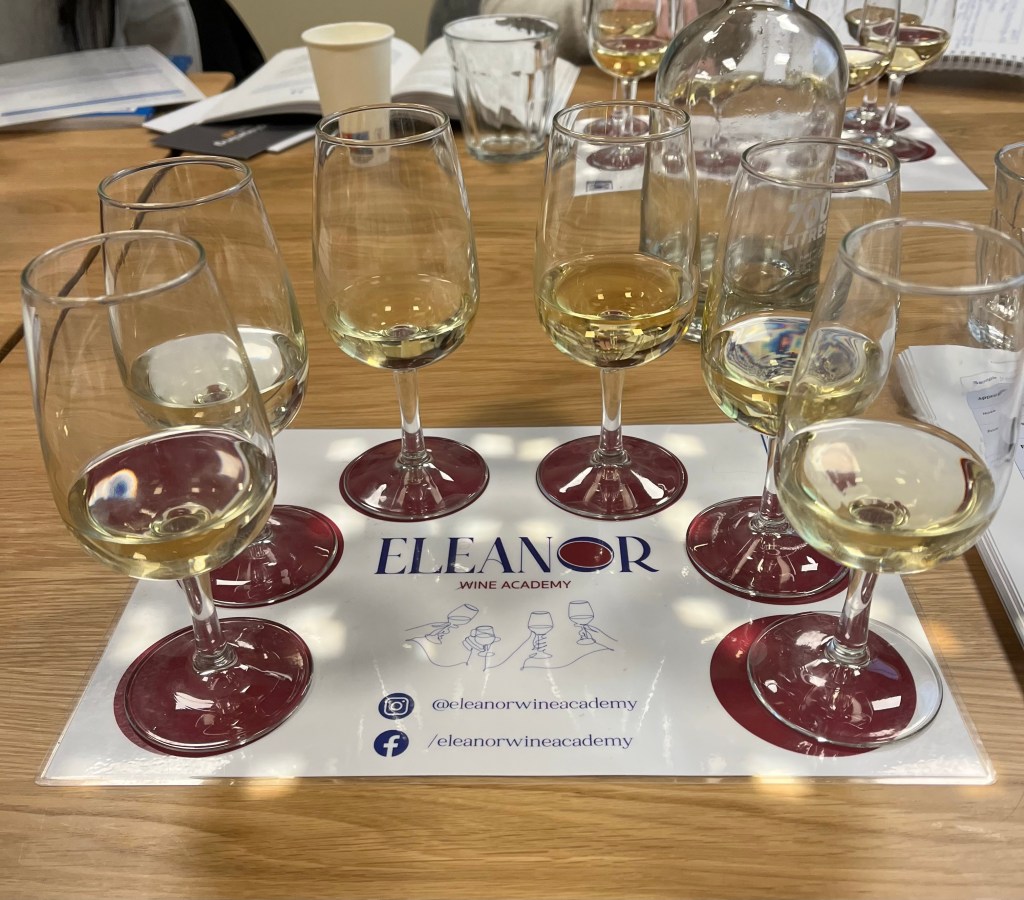
A few observations from class thus far:
- My humble opinion: these glasses are too small for educational purposes. Yes, they are the size of conventional tasting glasses, but coaxing the aromas we’re supposed to be identifying is harder when the bowl of the glass isn’t very big.
- There is teaching, and there is teaching to the exam. So far this course does both, but more of the latter. My instructor is happy to answer our questions; he lets us know what info is relevant for the exam and what students will learn more of in level 3 (so hold brain space for then).
- Level 2 does not allow for nuance in description. Why do I have to choose “lemon” or “gold” to describe a white wine’s color when it’s really an in-between straw color? Why are we bound to 3 categories (e.g. light / medium / full body) instead of a wider spectrum? Fundamentals are important, but we can’t explore better descriptors until level 3. Whyyyy?
- This is a great time to begin using the wine spittoon… not something I did in the past, unless I really didn’t like the wine.
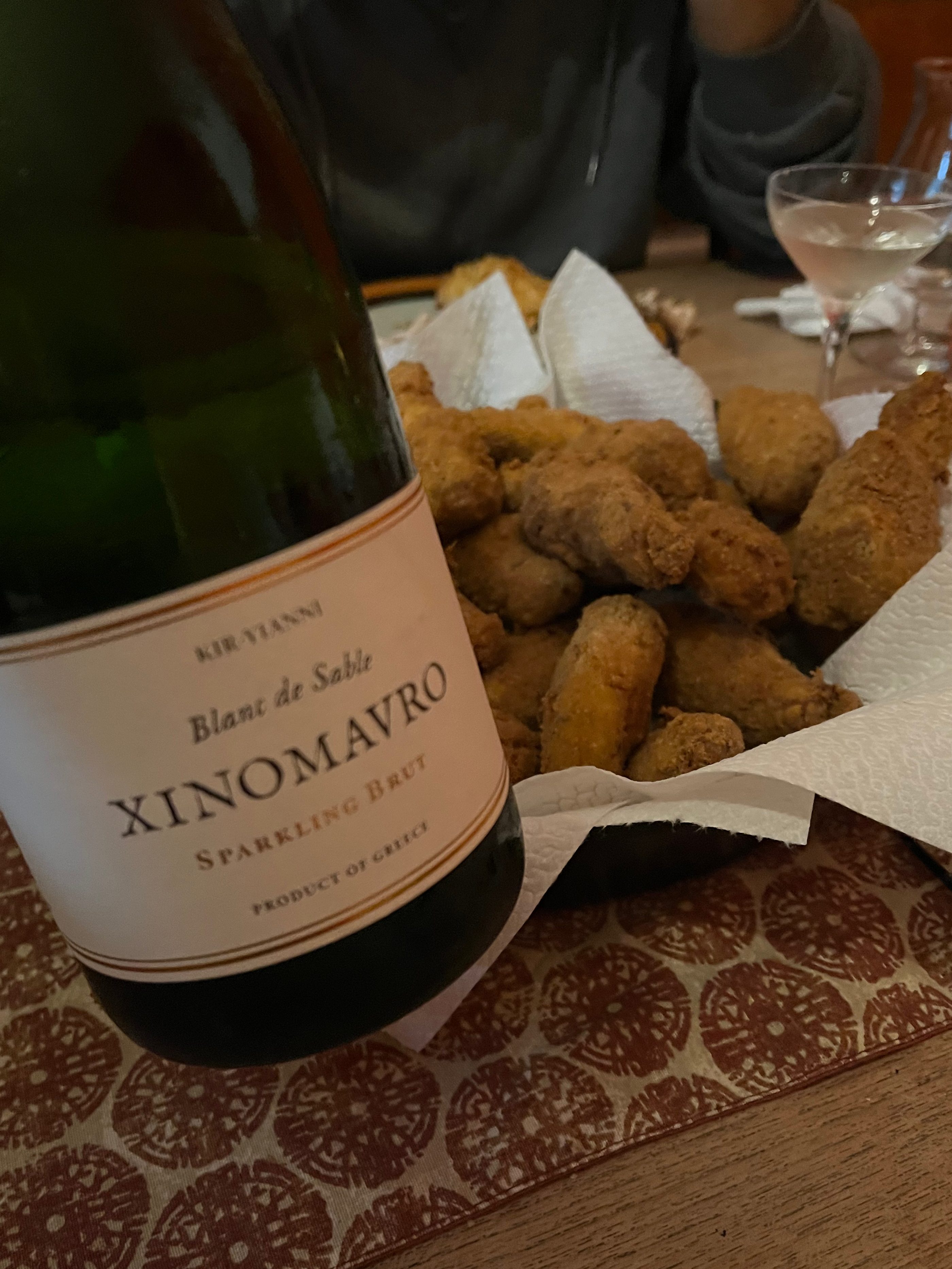
- Something I’ll enjoy exploring more in level 3 or on my own time is the science behind wine and food pairings; the Dutch call it wijn en spijs. In my own kitchen I like to play with uncommon but interesting pairings, like this sparkling Xinomavro with fried chicken wings.
Three more classes to go, then a final exam in Amsterdam on 26 February.
One of my own indicators that I’d like to move along this path is that I wasn’t put off by the professional exams. I’d not missed academia or other educational settings since getting my masters degree in 2011 and had been OK dodging certifications, language proficiency exams (looking at you, JLPT-ers), etc. This, though? I wanted to take on the challenge.
The learning curve between level 2 and level 3 is not a small one. Some 90+ percent of pupils pass the level 2 exam; about half that number pass level 3. Level 3 is a lot more comprehensive, but tying into my opening paragraph, I think this will suit me fine… if I brush up on my study skills.
 she's making Pour Decisions
Leave a comment